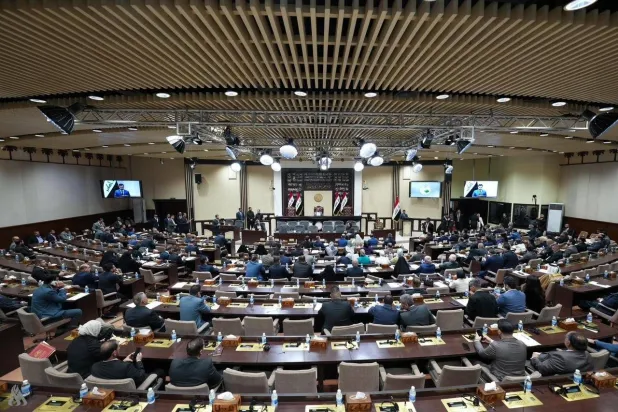
Iraq’s parliament is scheduled to vote on Thursday on the cabinet lineup proposed by Prime Minister-designate Ali Falih Al-Zaidi, amid ongoing political disputes over key ministries and newly proposed posts.
Parliament’s media office said the agenda for session No. 24 includes a single item: a vote on “the government program and cabinet of Prime Minister-designate Ali Falih Al-Zaidi,” signaling efforts by political blocs to move forward with approving the new government despite lingering divisions, particularly within the Shiite Coordination Framework alliance.
Political and parliamentary sources said negotiations were continuing over several sovereign ministries, four deputy prime minister posts and two proposed new ministries, as pressure mounted to finalize the government before the Eid holiday to avoid a political vacuum or possible security escalation.
A source familiar with the talks told Asharq Al-Awsat that most lawmakers had not yet reviewed the résumés of ministerial nominees, despite constitutional requirements that they be distributed to parliament members before the confidence vote.
“Most lawmakers are not part of the negotiations taking place among bloc leaders, which are focused mainly on dividing ministerial quotas under the points system, while disagreements continue over some sensitive positions,” the source said.
Despite a relatively calm political atmosphere ahead of the session, political sources spoke of possible “last-minute surprises,” citing disputes within some parties over government priorities, particularly the issue of restricting weapons to state control.
A politician familiar with the negotiations noted that some leaders within the Coordination Framework had become less enthusiastic about backing Al-Zaidi than they were at the start of his nomination process, partly because of his pledge to place all weapons under state authority and concerns over his future relationship with armed factions allied to the coalition.
Some factions believe Al-Zaidi enjoys “clear international and American support,” the source said, referring to statements by Western officials in recent weeks that have fueled fears among some political groups that the next government could adopt a tougher stance on weapons outside state control.
Local media reports said resistance by some armed factions to disarm was one of the main reasons for delays in finalizing the cabinet, while political analysts also pointed to disputes among parties over the allocation of ministries.
A committee formed by the Coordination Framework has discussed the issue of weapons control with Al-Zaidi, while some armed groups continue to reject disarmament because of uncertainty over the future of their arsenals, the source added.
On the Sunni side, political factions appeared close to finalizing their ministerial share. Media linked to the Taqaddum party led by Mohammed Al-Halbousi circulated names of nominees and details of the distribution of ministries among Sunni blocs.
According to the reports, Taqaddum would receive the education and industry ministries, in addition to a deputy prime minister post, while the commerce ministry would go to the Al-Siyada party led by Khamis Al-Khanjar. The defense ministry would be assigned to the Hasm alliance headed by Thabit Al-Abbasi, and the planning ministry to the party of Muthanna Al-Samarrai.
Among Kurdish parties, there are signs that the Kurdistan Democratic Party would receive the foreign ministry and a deputy prime minister position, while the Patriotic Union of Kurdistan would take the construction and justice ministries.
In his first public comments on the government formation process, Al-Zaidi said he would “not respond to any personal demands” while selecting ministers, adding that he had secured Kurdish backing following meetings in Erbil.
Al-Zaidi said he aimed to form “a strong and solid economic government,” signaling that economic and development issues would be prioritized by his cabinet.