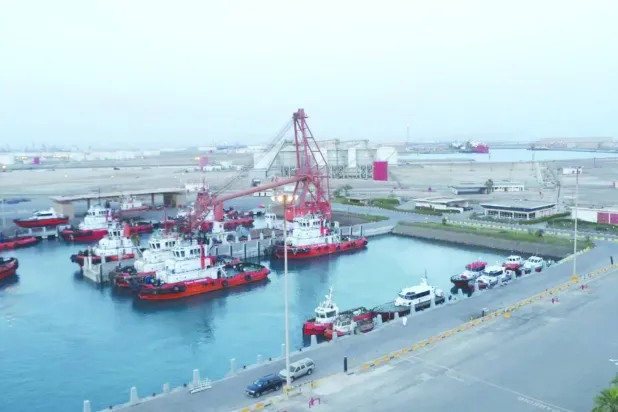
Amid growing maritime disruptions across global shipping routes, Saudi Arabia’s export capability through the Red Sea has emerged as a strategic safeguard against a surge in global energy prices.
Kristijonas Gedvilas, Chief Executive Officer of the European Chamber of Commerce in the Kingdom of Saudi Arabia (ECCKSA), said the real value of the alternative corridor lies in its ability to guarantee crude flows and ease inflationary pressure on European consumers and industry. He added that cooperation exceeding €88 billion in 2025 reflects Saudi Arabia’s transformation into a strategic partner in European energy security, supported by one of the world’s most resilient logistics infrastructures.
Gedvilas told Asharq Al-Awsat that Riyadh’s success in providing an alternative maritime route through the East-West pipeline was not merely an emergency response, but a step that reinforced the Kingdom’s strategic importance globally. He said Saudi Arabia’s dual-coast export capability across both the Gulf and the Red Sea had effectively eliminated dependence on a single maritime chokepoint, ensuring continuity of supply even under conditions of acute regional tension.
Asked about the corridor’s direct impact on Europe, Gedvilas said its short-term relevance lies primarily in price stability rather than physical supply security, though its long-term significance is considerably greater, positioning Saudi Arabia as a strategic partner in Europe’s energy transition.
“The corridor’s significance for Europe extends well beyond its immediate role in securing crude oil flows. It represents a strategic shift in how Saudi Arabia connects to Europe’s future energy system as a whole,” he said.
“Emerging multi-molecule export hubs such as NEOM and Yanbu position the Kingdom at the centre of future green fuel supply chains.”
On this subject, Gedvilas explained that Saudi Arabia is exporting hydrogen and ammonia directly into the South H2 Corridor towards Italy and Germany in support of Europe’s industrial decarbonisation agenda. He added that the Saudi-Egypt electricity interconnection creates another dimension by paving the way towards integration with European grids and supporting Europe’s growing demand for diversified, low-carbon energy sources.

Structural Contributions to European Cost Stability
Gedvilas stressed the need to define the strategic impact of the alternative corridor from a precise European perspective, noting that the European Union imports around 10 percent of its oil needs from the Gulf. “The primary consequence of Hormuz-related disruptions for Europe is not a direct supply shortage, but rather upward pressure on global oil and gas prices,” he said.
He added that “the corridor’s contribution to market continuity has a real, even if indirect, effect on European energy costs,” helping contain energy price pressures across the continent and protect industrial sectors from market volatility.
The situation recalls the severe challenges Europe faced in 2022 during the gas crisis triggered by the Russia-Ukraine war, when reduced supplies placed unprecedented pressure on companies and consumers and forced European governments to spend hundreds of billions of euros in emergency support measures. Today, the Saudi alternative corridor is helping shield European consumers from another inflationary shock.
Sovereign Reliability
Gedvilas said Saudi Arabia’s position as a leading OPEC member and one of the most consequential actors in global oil markets, with production capacity of around 12 million barrels per day, is rooted in a longstanding record of securing global supplies and moderating price fluctuations during periods of market stress. He noted that the Kingdom has largely maintained that role despite the current wave of regional disruptions testing global energy security.
“The alternative corridor reinforces this reliability in a structural way,” Gedvilas said. “By giving Saudi Arabia a dual-coast export capability across both the Gulf and the Red Sea, it eliminates dependence on a single maritime chokepoint and ensures continuity of supply even under conditions of acute regional tension.”
Saudi Resilience Versus European Exposure
The ECCKSA chief executive said the Kingdom’s integrated export and petrochemical infrastructure has cemented its position as one of the world’s most resilient energy partners. This strategic strength comes at a time when the energy shock caused by the war exposed Europe’s dependence on traditional supply routes, with the continent still facing volatility in diesel and jet fuel markets and difficulties achieving full energy independence.
Against this backdrop of European vulnerability, Saudi Arabia has emerged as an indispensable stabilising force, not only by securing physical supplies but also by protecting the European economy from geopolitical pressure linked to volatile international markets, according to Gedvilas.
Looking ahead, Gedvilas said Saudi Arabia’s role in stabilising global energy markets is set to expand significantly in both scale and nature. Historically regarded as a cornerstone of hydrocarbon security, the Kingdom is now playing a leading role in the global transition towards sustainable energy and green hydrogen production.
He said this forward-looking dimension ensures Riyadh will remain a cornerstone of the emerging global energy system, strengthening Saudi Arabia’s reliability as a long-term strategic partner for Europe capable of safeguarding energy security against future geopolitical pressures and market disruptions.