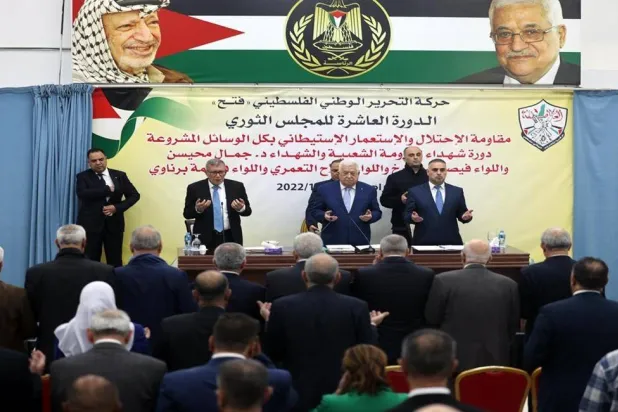
Palestinian president Mahmoud Abbas’s Fatah movement is due on Thursday to elect a new central committee for the first time in 10 years, as it faces existential challenges in the wake of the Gaza war.
During the three-day general conference, the movement will vote on the central committee, its highest leadership body, even as analysts warn of Fatah’s diminishing legitimacy in the face of endemic corruption and its lack of progress on Palestinian statehood — especially amid an intensified Israeli settlement drive, reported AFP.
The committee is expected to play a key role in the post-Abbas era, with some wondering whether the 90-year-old leader might finally step down after more than two decades at the helm, despite the lack of a clear heir apparent.
The conference comes as the Palestinian national movement is facing some of “the most serious challenges in our struggle”, said Jibril Rajoub, the current secretary general of the committee.
He expressed hope that the conference, repeatedly delayed, would contribute to “ensuring and protecting the establishment of a Palestinian state on the world’s agenda and protecting the Palestine Liberation Organization as the sole legitimate representative of the Palestinian people”.
Fatah has historically been the main component of the PLO, which includes most Palestinian factions but excludes Hamas and Islamic Jihad groups.
In recent decades, Fatah’s popularity and influence have dwindled amid internal divisions and growing public frustration over the stagnation of the Israeli-Palestinian peace process.
The sense of disappointment led to a surge in support for rival Hamas, which made huge political gains in the occupied West Bank in 2006 elections that it won handily, before going on to expel Fatah from the Gaza Strip almost entirely after a bout of factional fighting.
Hani al-Masri, director of the Palestinian Center for Policy Research and Strategic Studies (Masarat), told AFP that Fatah now merely uses the PLO to provide itself with legitimacy, “a legitimacy that is eroding in the absence of a unified national project, elections and national consensus”.
He added that Thursday’s conference was overshadowed by competition over seats on the central committee, “while the national project is conspicuously absent from the discussions”.
Rajoub nonetheless declared that the conference was a first step towards “putting the Palestinian house in order, to build a partner for establishing a (Palestinian) state”.
– Succession –
The conference will be held over three days, with approximately 2,580 Fatah members participating, the majority of them in Ramallah, though several hundred are also spread across Gaza, Cairo and Beirut.
They are expected to elect 18 representatives to the central committee and 80 to the movement’s parliament, known as the revolutionary council.
Fatah is the main party within the Palestinian Authority (PA), which has been touted abroad as a natural partner in rebuilding and running the Gaza Strip after Israel’s devastating war with Hamas there.
But Fatah remains marginalized in the territory, and Israeli Prime Minister Benjamin Netanyahu has repeatedly vowed that it, the PA and Hamas will have no role in post-war governance.
Despite repeated declarations from the movement that it is working as a “united front”, major figures will be absent from Thursday’s conference, notably Nasser al-Qudwa, a key Palestinian leader who is boycotting the gathering.
“This conference is illegitimate, and this leadership that has usurped power is illegitimate and its time is up,” said Qudwa, a nephew of late Palestinian leader Yasser Arafat.
Key figures competing to replace Abbas include Rajoub and PA deputy Hussein al-Sheikh.
Also missing is Marwan Barghouti, who is considered a uniquely unifying Palestinian leader often cited as a possible successor to Abbas, but is serving a life sentence in Israeli prison after being found guilty of involvement in deadly attacks.
Meanwhile, the president’s eldest son, Yasser Abbas, is on the ballot to join the central committee, having risen in prominence over recent years after he was named the president’s special representative despite largely residing in Canada.
Al-Masri said the president’s son’s bid for a seat “indicates a trend towards dynastic succession”, which is “extremely dangerous for Fatah, the Palestinian Authority and the Palestinian cause”.