Blog

  • Hamas Nears Final Step in Choosing New Political Chief

    Hamas Nears Final Step in Choosing New Political Chief

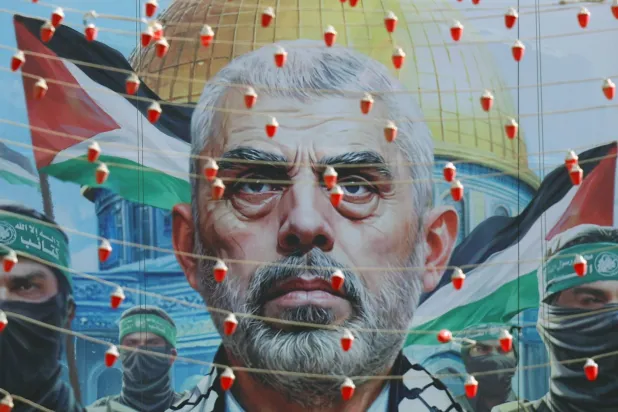
    Hamas is close to electing a new head of its political bureau, who will oversee the movement until the end of this year or early next year, pending broader internal elections in the Palestinian territories and abroad.

    Asharq Al-Awsat learned from three Hamas sources outside Gaza that members of the movement’s political bureau — excluding those already in Gaza and the West Bank — along with members of its Shura Council, have been meeting in Istanbul for several days. Participants also attended funeral ceremonies for Azzam Al-Hayya, the son of Khalil Al-Hayya, Hamas’ political leader in Gaza.

    According to the sources, Khalil Al-Hayya traveled from Türkiye to Qatar to be with his family after his son Azzam was killed in an Israeli airstrike last Wednesday. The strike also reportedly killed a field commander from the elite forces of the Al-Qassam Brigades, Hamas’ armed wing.

    The sources said Al-Hayya is expected to return to Istanbul to resume his duties, including preparations for the final phase of selecting Hamas’ new political bureau chief.

    Hamas is facing what observers describe as its most severe crisis since the movement was founded in 1987. Israeli operations launched after the October 7, 2023 attack have targeted multiple branches and leadership levels within the organization, creating significant organizational and financial strains.

    Current assessments suggest that Khaled Meshaal, Hamas’ external political chief, and Khalil Al-Hayya are the leading contenders for the top position.

    The movement is waiting for what sources described as “appropriate security and political conditions” before holding comprehensive elections across Palestinian territories and Hamas’ overseas branches to choose a new Shura Council, political bureau, executive body, and regional leadership structures.

    For roughly the past year and a half, Hamas affairs have been managed by a temporary “leadership council.” Earlier this year, the movement began efforts to select a leader to complete the remainder of the current political bureau’s term, which was originally due to end in 2025 but was extended by one year until broader elections can be held late this year or early next year.

    Momentum Builds Around Al-Hayya

    Sources outside Gaza said Hamas could announce the identity of its new political bureau chief within days, possibly by the end of this week or early next week.

    A fourth Hamas source in Gaza told Asharq Al-Awsat that some within the movement are pushing for Al-Hayya’s election, particularly after the killing of his fourth son.

    With Azzam Al-Hayya’s death last week, Khalil Al-Hayya has now lost four sons in Israeli strikes. Earlier, Azzam’s twin brother, Hammam Al-Hayya, was killed in a strike targeting Hamas leaders in Doha in September 2025.

    New Mediation Proposal Expected

    A Palestinian faction source said mediators, particularly Egypt, are expected to present a revised proposal aimed at narrowing gaps between Hamas and Israel. The source said Israel’s response to the latest framework remained negative, citing disputes over weapons, withdrawal terms, and reconstruction conditions.

    Meanwhile, Israel intensified accusations that Hamas is rebuilding military infrastructure, manufacturing weapons, and exploiting humanitarian aid through taxation. Hamas spokesman Hazem Qasim rejected the claims, saying they were intended to justify continued Israeli military escalation and tighter restrictions on Gaza.

    Qasim also said Hamas remains committed to the Sharm El-Sheikh ceasefire agreement signed in October 2025, despite what he described as thousands of Israeli violations since the truce took effect. According to the report, more than 856 Palestinians have been killed since the ceasefire began.

    Original Post

  • Have We Moved from Epic War to Local War?

    In two important statements, US Secretary of State and National Security Adviser Marco Rubio said that the battle of the Operation Epic Fury had ended and achieved its objectives. As for the developments that followed the ceasefire, President Donald Trump said that the Iranians “messed with us today and we crushed them.” He said they “trifled” and that the whole thing is not worth dwelling on.

    Does this mean America has now achieved its mission and that we have entered the day after the epic war? Or was it merely a psychological withdrawal from the scene, with the weapons and military hardware still in place and an explosion possible at any moment? And why this position, at least at the rhetorical level? Is the aim to ensure a peaceful climate for the World Cup that the United States is hosting alongside Canada and Mexico? Or does it reflect fears of a shift in American public opinion that could cost the Republicans in the Midterms and deprive them of control over both the Senate and the House?

    Wars generally end either with a political settlement or the collapse of one of the parties. So what is happening exactly? What happens if the US leaves the Middle East mired in a war with no end in sight? Why is the US behaving this way? Is it the World Cup that begins in a month, the midterm elections in November, or both? Or is it simply down to President Trump’s “transactional politics” and the politics of deals?

    It is perhaps a mix of all these factors. Trump administrations, as we have seen over two terms, do not pursue long-term strategic foreign policy projects, preferring a series of temporary deals because they believe that long term outcomes are an accumulation of short-term phases, each of which must produce a direct and rapid return.

    With this mindset, the war becomes a tool to exert pressure rather than a project for reshaping the region. Here, Trump’s vision diverges from Netanyahu’s. The latter wants to change the face of the Middle East. Ending the war, therefore, becomes more important than a decisive victory. Total victory requires time, money, and a long-term commitment that Washington wants to avoid at this stage and that does not align with President Trump’s governing approach. Trump is the real actor in this war; or, to be fair, Trump and the market are.

    This shift in rhetoric, from both the president and his secretary of state and national security adviser, show that Washington may no longer be bent on achieving a historic victory. It now seeks to avoid being bogged down in a new Middle Eastern quagmire like those of Iraq or Afghanistan. It seems to be saying: we carried out this punitive mission, and that is the end of it; managing the day after is the responsibility of the region.

    The problem of the Strait of Hormuz remains. Contrary to what some believe, it actually boosts American oil and gas. Yes, closing the strait hurts the global market and the broader global economy, but its direct impact on the American treasury is decidedly positive and symbolically advantageous.

    Nonetheless, the prestige of the great powers that shape the balance of power in the region and the world still matters. The problem is that the Middle East cannot tolerate a vacuum. If the major power withdraws before reaching a real political settlement, regional powers quickly find themselves managing open-ended conflicts waged through local proxies. That is precisely what makes “local war” so dangerous: it continues because the regional actors have their own reasons for perpetuating it and the major powers lack the will to bring it to an end.

    Current indications suggest that this is a highly probable outcome. Israel does not appear prepared to return to the prewar status quo, Iran cannot behave as though nothing had happened, and the Gulf states could once again find themselves hostages to geography.

    Here lies the real concern: the US may have ended its “great epic,” but in doing so, it could leave behind a Middle East of small wars with no end in sight.

    Original Post

  • The Wave of Treason Accusations, Escalating Rhetoric, and the Repercussions for Lebanon

    As Hezbollah escalates rhetorically and raises the stakes, there is a need to examine the wave of treason accusations and verbal escalation it has directed at the Lebanese presidency, the premiership, and the Maronite religious establishment. At first glance, this virulence seems a purely domestic matter. In fact, however, it is tied to sweeping regional swifts. Lebanon stands on a fault line between two paths: the path of sustainable peace and the path of resistance and endless cycles of war.

    Why this escalation? It cannot be understood without taking a moment to consider a number of domestic factors. The first concerns the nature of Hezbollah’s political project itself. The idea of direct negotiations with Israel (or even of lasting peace) is not merely a political alternative; it undermines at the essence of the narrative that the “resistance” has been built for decades. The transition from the logic of “open-ended conflict” to that of a “stable settlement” would strip the resistance discourse and its proponents of legitimacy. Accordingly, its escalation is a response to an existential threat to its entire model, not a fleeting reaction.

    The second factor is the transformation of the state’s leadership. Since the era of Syrian hegemony and the years that followed, the party had grown accustomed to having the final say on questions around, leveraging domestic alliances that provided it with political cover, notably when Michel Aoun provided it with a large Christian umbrella. Today, with the Lebanese authorities seeking to restore institutional logic, its monopoly over decision-making can no longer be taken for granted. The escalation, therefore, reflects Hezbollah’s refusal to accept this new equation and its attempt to reestablish its influence. We should not overlook the circumstances surrounding Joseph Aoun’s accession to the presidency following the regional earthquake triggered by the response to the “Al-Aqsa Flood” operation and the subsequent regional shifts that have changed the balance of power and overturned the equation since, including the push to end clamp down on nonstate actors.

    The third factor is the struggle over the right of representation. When the state approaches a sovereign decision such as negotiations, the question remerges: who has the authority to define the national interest? Attacks on the presidency and the premiership seek to redraw the boundaries of legitimacy and institutional authority. The party does not appear ready to accept the authority of constitutional institutions without gains that would redistribute the balance of power within the Lebanese political system. As for the targeting of the Christian religious authority, this is intended to move the dispute from the technical-political field to that of identity, ensuring that the debate over Lebanon’s choices becomes a debate over Lebanon’s very definition.

    This shift is no trivial matter. It opens a dangerous door and turns political disagreement into a combustible social crisis. Is the aim, then, to push the country toward implosion? It would be more accurate to say the opposite. Hezbollah is taking a calibrated approach to leave Lebanon on the brink with no actual intention to fall into the abyss. The goal is to deter the authorities from going too far in these negotiations and to test the other side’s capacity to mobilize popular support. If limited frictions break out, they can be politically exploited; if they do not, the message would have been delivered at low cost. In this game of brinkmanship, tensions are leveraged as a tool rather than an end in themselves, and obstruction is always an option whenever outright dominance proves elusive.

    In this context, the objective is not to break institutions but to domesticate them and prevent negotiations from evolving into an independent process that imposes changes that can no longer be controlled later on.

    The regional dimension remains the most influential factor in containing things. Domestic escalation cannot be understood solely as a Lebanese conflict. It is a manifestation of ambiguity surrounding American-Iranian relations. Since Trump announced the end of military operations against Iran without an agreement, the region has been a gray zone: neither a decisive war nor a completed settlement. This leaves fragile arenas such as Lebanon exposed to open-ended competition. Hence Israel’s assassination of the commander Ali Ballout in Beirut’s southern suburbs despite the truce. Washington’s position creates a vacuum of authority and pushes local actors to redraw their own red lines, turning escalation into a message to the domestic arena: any process that ignores existing balances of power will remain untenable. It also sends a message to external actors: no arrangement that disregards this calculus will ever be consolidated.

    The United States’ ambiguity coincides with Israel’s drive to impose new facts on the ground in the south, placing Lebanon in a difficult position: mounting military pressure on one hand and an uncertain negotiating track on the other. Caught between the two, the domestic arena withers and becomes increasingly susceptible to home to efforts to apply pressure on rivals.

    This trajectory is not dangerous because it raises the specter of an implosion, but because it normalizes controlled tension. When a country is managed on the edge of the cliff, the exception becomes the rule, and the boundaries between politics and security (and between the state and its parallel bodies) begin to dissolve. Over time, the problem begins to move beyond periodic rounds of escalation and leaves the country permanently on the edge of sectarian strife, gradually waning.

    Original Post

  • The Russian Guide and the Beijing Summit

    The pains of the day gather in the night. The keeper of the seals sits alone. With exhaustion. With the mirror. With history. “Victory Day,” celebrations of Nazism’s defeat, were underwhelming. The attendance of foreign signatures was not befitting of Russia. He did not feel the powerful’s exhilaration nor the awe of the celebrations. He struggled to hide his disappointment. How he longed to announce an overwhelming victory over Ukraine that day. It had betrayed Russia’s embrace and its Soviet past. How he longed to announce that the reckless president of that state would be arriving the next day to surrender and publicly repent for attempting to stab the motherland in the back. But that was not possible.

    Anger seeps through his veins. It is no small matter for Russia to scale down its “Victory Day” parade for fear of a former actor named Zelensky’s drone threats. The tsar needed the master of the White House to intervene and secure the parade by mediating a brief truce. During the parade he looked at his generals, at the clusters of medals hanging from their chests. The odor of his disappointment filled the air. What use are all these medals if an actor’s drones keep Moscow awake at night? It was as though Russia’s splendor had come to an end. Its generals shine at lavish banquets, not the battlefield. Comrades from North Korea took part in the parade. He has not forgotten that Kim Jong Un rescued the Russian army during its harshest battles in Ukraine. The Russian army also relied on thousands of mercenaries from Colombia, Africa, and the Arab world, a bitter stain on the history of the “Red Army.”

    The past few months have been especially brutal. Donald Trump sent his bombers and Iranian nuclear facilities were pounded. Israeli fighter jets roamed Tehran’s skies like they had been on an excursion. The year began painfully too. Trump dispatched elite units who seized “Comrade” Nicolas Maduro and brought him before an American court like Noriega or Escobar. His “strategic partnership” with Russia did not save him. Castro’s country is shaking in the agony of economic failure according to reports, and it can not avoid publicly admitting defeat and surrendering to geographical destiny for much longer.

    There are many painful scenes. Israeli aircraft decimated Iran’s leadership, foremost among them the Supreme Leader himself. American planes rained bombs on the barracks and the prestige of the IRGC. Iran set off the Strait of Hormuz detonator, but the fleets of the “Great Satan” have surrounded its ports and strangled its economy.

    Russia cannot risk confronting the American machine. Its strategic partnership with Iran will go no further than smuggling spare parts to allow Iran to replenish its drone arsenal. Besides, Russia needs the tweeting master of the White House to arrange the “Victory Day” truce and help find a way out of the Ukrainian swamp.

    He understands his advisers, assistants, and flatterers. They have no interest in unsettling the decision-maker or provoking him. Their fate hinges on his mood. They sugarcoat death and cover the thorns with velvet. But the tsar knows. Rising oil prices do not change the fact that his country’s economy is not in great shape, nor that the war has dragged on and that its agon has entered many homes.

    Fortunately for him, the regime can keep the mothers of fallen soldiers from weeping on television screens. It criminalizes skepticism of the war or its objectives. True, he is not the president of America, forced to live in fear of newspaper headlines and the flames of social media. Russian media, like its security, is tightly controlled . But even that is not enough.

    The war in Ukraine has dragged on and will soon outlast the Second World War. Every day coffins return from Ukraine wrapped in the Russian flag, as though the flag’s only remaining function were to cover coffins.

    The tsar knows. For the first time since his rise to power at the start of the century, his popularity is slipping in the polls, even if it remains far higher than Trump’s. That is why he tried to offer a glimmer of hope, saying the war was nearing its end. Sometimes it occurs to him that he had entered the Kremlin to restore Russia’s greatness just as Trump entered the White House to make America great again.

    That week will not spare him from the painful scenes. The world’s attention will turn to Xi Jinping and his guest Donald Trump. The talks will certainly not be easy. The global economy has been hit with the radiation of the Strait of Hormuz, and market fears have risen to unprecedented levels. Both presidents have many concerns and profound disagreements. On the table lie the troubled international economy, supply chains, tariffs, rare earth minerals, artificial intelligence, chips, and the feverish technological race, to say nothing about Taiwan. Fortunately for the world, the Chinese emperor has not dealt with “treacherous” Taiwan the way the Russian tsar has dealt with Ukraine. The question is whether Trump can satisfy Xi enough to use the Chinese key to unlock the Strait of Hormuz.

    Vladimir the Great knows that the Chinese president now sits in the seat once reserved for Leonid Brezhnev. Newspapers will write of the global powers’ summit and how the fate of the world hangs in the balance, just as they had once written the same about Soviet-American summits. They will also write that the summit will merely manage their competition for first place and seek to prevent dangerous escalation. The contest for world leadership will remain between Washington and Beijing. Some will not hesitate to write that the best Trump can achieve is merely to delay the emergence of the “Chinese era.”

    Putin boasts of a “friendship without limits” that ties him to the man on Mao Zedong’s throne. But the term “Chinese century” gives him pause when he reflects on his country’s geographic destiny. A technological and human flood. He thinks of something else.

    Has the Russian Supreme Leader been wounded in the Ukrainian war? This question torments him. He looks in the mirror, trying to blame his age, smelling the autumn. But Xi was born only a year after him, and Trump was born six years before him. He has the sense that Russia itself has also been wounded. The wheel of time turns. From now on, Russian may have to content itself with playing in the second division.

    Original Post

  • Leaving Politics Out of Hajj

    Millions have watched the videos of Iranian pilgrims being received in Madinah and saw how they were greeted warmly and presented with flowers as they arrived, one after the other, to perform the Hajj pilgrimage this year. They were at ease, in safety, and far from the fallout of the war that has swept through the Middle East and the complex political and security realities that it produced.

    These scenes surprised observers unfamiliar with Saudi policy. Moreover, Saudi Arabia had itself been the target of several Iranian ballistic missile and drone attacks during the war between Israel and the United States on one side and Iran on the other since February 28. The Kingdom was not a belligerent in this war; on the contrary, it had been proactively seeking to spare the region from violence and chaos through diplomacy, in order to resolve differences and reach sustainable diplomatic solutions, repeatedly reaffirming that it would not allow its territory, airspace, or territorial waters to be used for offensive operations. Even so, it was subjected to wanton Iranian attacks on vital civilian infrastructure and strategic facilities, damaging its national security.

    To this behavior, Iran’s open violation of international law, Saudi Arabia responded with defensive military measures and diplomacy. It also drew a clear line between politics on the one hand and the serving of the pilgrims of making Hajj to the sacred house of God on the other. Even when those pilgrims came from the country that had attacked the Kingdom, Riyadh did not receive them as though they had been responsible for those attacks, but as guests who had come to perform religious rites and visit Makkah and Madinah.

    During the 12-day war between Israel and Iran in 2025, thousands of Iranian pilgrims had been in Saudi Arabia and could not return to their country. Custodian of the Two Holy Mosques King Salman bin Abdulaziz issued directives to the Ministry of Hajj and Umrah to “facilitate all the needs of the Iranian pilgrims and provide them with all the services they need until conditions would allow for their safe return to their homeland and families.” The Saudi authorities carried this out with great efficiency under the close supervision of Prince Mohammed bin Salman, Crown Prince and Prime Minister.

    To the Saudi government, what matters is adhering to the laws governing Hajj and totally avoiding any “politicization of Hajj,” including through slogans or images, and revolutionary speeches by any party whatsoever. This refusal to use religious rites as a political tool is not new, nor is it tied solely to recent developments in the Gulf. It is a longstanding Saudi policy aimed at ensuring that Hajj remains highly organized, safe, and spiritual – at arm’s length from division, discord, or sectarian fanaticism.

    In this context, it is worth recalling remarks of Major General Mohammed al-Omari, commander of the Saudi Special Emergency Forces, who stated that “the primary goal of the forces is to preserve the security of Hajj and the safety of the guests of God.” He stressed that pilgrims should be treated “with the utmost comfort and care,” adding that “the security of Hajj is a red line; we will not allow anyone to approach it, let alone cross it.”

    Such explicit rhetoric is meant to create a clear deterrent against any unlawful act before it occurs. Without it, the pilgrimage season could descend into disorder and become a space exploited by partisan groups to promote their ideas, recruit followers, and mobilize their bases, a real threat to pilgrims, visiting delegations, and Saudi security alike.

    Historically, the kings of Saudi Arabia have always regarded “Custodian of the Two Holy Mosques” as the title dearest to them. It confers to them the honor of overseeing the Holy Kaaba in Makkah, the Prophet’s Mosque in Madinah, and other holy sites. They therefore see themselves as being personally responsible for the comfort and safety of pilgrims, and for ensuring that they return to their homelands safely.

    According to sources I spoke with, several religious authorities in the seminary of Najaf in Iraq and the seminary of Qom in Iran have stressed the importance of complying with Saudi regulations. They have unequivocally reiterated that violating the Kingdom’s law is “religiously forbidden” and that Iranian pilgrims, like all others, must follow the instructions of the Saudi authorities because safeguarding order is among their highest obligations.

    Saudi policy has consistently rested on preventing the use of religion for political or partisan ends and on providing the pilgrims of the sacred house of God with every service they need, including medical care and logistical support, regardless of where they come from. The underlying principle, throughout, is adherence to the law, refusal to politicize Hajj, and the conviction that the security of Hajj is a red line Riyadh will not allow anyone to cross.

    Original Post

  • What Does the Age of ‘Nationalisms’ Mean for the Future of a United Britain?

    Few observers were surprised by the local election results in Britain and Northern Ireland yesterday. Opinion polls had already shown that the ruling Labor Party was heading toward a painful defeat under its weak, opportunistic leadership that lacks substance, conviction, and charisma.

    Its current leader’s rise to power in the 2024 general election was more the result of others failures than through any merit of its own. Labor’s share of the vote in this seemingly sweeping victory was telling: the party won 411 seats with only 34 percent of the vote.

    That is, Labor had increased its vote share by no more than 1.6 percent after the defeat of 2019. Indeed, that 34 percent was the lowest vote of any party with an outright parliamentary majority since the end of the Second World War.

    The Conservatives, meanwhile, saw their share collapse, from 44 percent in 2019 to just 20 percent in 2024. The centrist Liberal Democrats raised their share to 12.2 percent, a gain of 0.7 percent. But most of the Conservatives’ votes had gone to the far right- the Reform Party born from the twin of Brexit and hostility toward immigration and immigrants.

    Indeed, Labor did not win the 2024 election by offering a coherent alternative grounded in a solid set of values. It won because it had benefited from chaos and divisions at the top of the Conservative hierarchy on one hand, and from the rise of a populist party, Reform, that was more extreme and more hostile to immigrants than even the Conservative right on the other.

    Even so, despite the generous and largely undeserved mandate that Labor and its leader had received, the current Prime Minister, Keir Starmer, chose to settle scores within the party rather than reaching out to its various factions and defusing their desire for revenge.

    Backed by the right wing of the Labor party that had dominated the party under former Prime Minister Tony Blair and his former ally Peter Mandelson (the most powerful and influential figure in Blair’s circle, Starmer launched a ferocious campaign against the remnants of the party’s previous left-wing leadership.

    After the 2024 elections, the Conservative Party was in shambles. The defeat not only cost the party power but opened the floodgates to defections. A number of hardline Conservatives left to join the extremist Reform Party, among them several senior ministers from recent Conservative governments. Ironically, some of these defectors had themselves been born to immigrants from ethnic and religious minority communities, including Hindus, Muslims, and Buddhists.

    As for Britain’s “two-party system,” which goes back to 1721, it is worth recalling that between 1721 and 1924, the two rivals were the Whigs, who later evolved into the Liberal Party after absorbing various groupings, and the Tories, the Conservative Party. Since 1924, the Conservatives and Labor have been the two key players.

    The most significant political shift seen in yesterday’s results was the rise of “nationalist” sentiment across the board: both in their proto-independence form in the non-English political entities (Scotland, Ireland, and Wales), and in their isolationist, anti-immigrant form in England itself, though Reform also made inroads in the non-English entities.

    These two nationalisms are ideological rivals. The racist and economic notions of the far-right that underpin Reform’s isolationism across Britain and Northern Ireland present a stark contrast to the “nationalism” of the Scots, Welsh, and Irish, which is rooted in notions of liberation from the weight of England’s old “colonial” legacy.

    In any event, Reform was the big winner in yesterday’s elections, followed by the Green Party, which many now regard as a credible alternative to Labor on the left.

    Reform’s rapid and alarming rise runs parallel to the broader ascent of far right, racist, and neo-fascisms movements from India to the Americas to Europe. What is happening today, however, cannot be understood in isolation from Margaret Thatcher’s legacy. Thatcher was the last Western leader to boycott South Africa’s apartheid regime. She waged wars of attrition against the welfare state that had been built in Britain after the Second World War. She had led the battle against “European identity” before her disciples and the heirs of her policies fulfilled her dream of separating Britain from Europe.

    At the time, Thatcher’s policies “complemented” those of Washington under Ronald Reagan. The European stage today, however, is far more complicated. The “special relationship” between Washington and London was real at the time; that is no longer the case. Thatcher was once the loudest of Washington’s European allies. Today, other European capitals are more “right-wing” than London, including Berlin. Moreover, conflicts within Europe are now shaped by the detente taking shape between Washington and Moscow.

    Personally, I believe the collapse of the two-party system in Britain will endure for some time. I also fear it may prove costly for both its internal stability and national unity, as it is difficult to imagine the nationalists of Scotland, Wales, and Northern Ireland finding comfort in a government headed by Reform extremists.

    Original Post